
Titus County Civil Docket Searches
Know the case type before you search. District civil and family cases go through the 76th or 276th District Court. Their records sit at the Titus County District Clerk. The County Clerk handles county civil matters, condemnation, and workers compensation. That work sits within the County Court's jurisdiction. Small claims, eviction, repair-and-remedy, and other JP civil cases stay with the Justice Court in the precinct that issued them.
For records, the County Clerk Court Records page leads through an acceptance notice to Texas Online Records. Its landing screen requires an account. The re:SearchTX portal gives credentialed users Cases, Filings, Text in Documents, and Hearings modes. Even so, statewide coverage does not promise a complete Titus County civil docket.
- Identify the court from the petition, citation, answer form, or prior order.
- Use the local clerk route and keep the full cause number and party style ready.
- Supplement the local search with re:SearchTX when the civil case is integrated.
- Read dated filings, service returns, settings, orders, and final disposition in sequence.
- Request the judgment or other record directly from the responsible clerk when needed.
When a docket search comes up empty, try a different clerk before you try different spellings. Run the name separately through the District Clerk, the County Clerk, and the right JP precinct. An appeal gets its own number in TAMES, so the original case number will not find it.
Titus County Civil Clerk Split
"Civil case" does not point to a single Titus County office. What matters is the amount in dispute. So do the case type and the jurisdiction the law assigns. The County Clerk describes its civil docket as cases under $20,000, condemnation, and workers compensation from 1983 forward. That description does not push every smaller dispute into County Court. Justice Courts still hear small claims, eviction, and repair-and-remedy matters. That is within their own jurisdiction.
| Civil track | Court | Record holder |
|---|---|---|
| District civil or family | 76th or 276th District Court | District Clerk |
| County civil, condemnation, workers compensation | Constitutional County Court | County Clerk |
| Small claims, eviction, repair and remedy | Justice Court | JP precinct clerk |
| Appeal after transfer | Sixth Court of Appeals | Appellate clerk |
Close calls can turn on the exact claim and on exceptions built into the law. When you call the clerk, give the case type and the amount rather than the dollar figure alone.
Civil Dockets: What They Show
A Titus County civil docket normally opens with a case header and then lists each filing or court event in date order. The local gateway requires an account, so anonymous visitors cannot open a live case. Treat any field list here as what to confirm on an authorized result, not as a promise of what the public screen shows.
| Cause number | The court’s local identifier, retained with its exact punctuation. |
|---|---|
| Style and parties | Plaintiff, defendant, petitioner, respondent, and attorneys when public. |
| Filing and service | Petition, citation issued, citation served, return, answer, and waiver. |
| Motions and orders | The filing of a request and the separate signed ruling, if entered. |
| Settings | Docket call, motion hearing, conference, trial, or reset information. |
| Outcome | Judgment, nonsuit, dismissal, settlement order, or appeal event. |
A portal result is only a pointer to the clerk's file. It is not a certified judgment. A document marked filed has not been granted, and a listed setting does not prove the hearing ever took place.
Titus County JP Civil Workflow
The Titus County Justice of the Peace page lists the precinct judges and clerks. It also lists phones, emails, forms, and payment routes. Start there for small claims, eviction, debt claims, and repair-and-remedy matters. Those do not belong to the County Clerk just because they are civil. The precinct clerk can confirm a cause number, answer status, and service return. The clerk can also confirm a court date.
The official Defendant Answer Form lays out two core paths. A defendant can admit the claim and consent to judgment. Or the defendant can deny it and ask for a court date. The form also offers a judge-or-jury choice. It warns parties to keep their address current. Debt-claim and small-claims packets gather the claim basis, requested relief, service details, party contacts, military-status information, and safety data. Those are filing fields. They are not proof that the public docket displays each one.
What Cases Fill the Civil Docket
Civil dockets in Titus County stretch across several court levels. The record type tells you the clerk, the forms, and what public material may appear.
- District civil disputes and major matters assigned to District Court
- Family cases filed with the District Clerk, with protected content where law requires
- County civil, condemnation, and workers compensation cases in County Court scope
- Small claims and debt claims in a Titus County Justice Court
- Eviction and repair-and-remedy cases in the correct JP precinct
- Civil appeals transferred to the Sixth Court of Appeals
Probate is civil in the broad sense. But Titus County routes probate and guardianship through the County Clerk and County Court. Keep those specialized records separate from a general civil docket search.
Titus County Civil Docket Timeline
A civil register usually opens with the petition or complaint and the creation of the cause number, style, court, and case type. Citation is then issued. Issuance and return are separate events. One creates the process. The other reports whether service occurred or was attempted. The defendant may answer, file a counterclaim, waive service, or request a jury.
Later docket entries can show discovery, motions, scheduling orders, mediation, temporary orders, and pretrial conferences. Notices and orders of setting put hearings or trial on the calendar. A continuance or reset moves the date. It decides nothing. At the close, the register may show judgment, nonsuit, dismissal, settlement order, post-judgment motion, enforcement, or appeal.
Civil flow: Petition › Citation › Service › Answer › Motions and Settings › Judgment or Dismissal › Appeal or Enforcement
Hearings on the Civil Docket
Read a setting entry for its date, time, courtroom, judge, and setting type. District Court settings can be confirmed through the coordinator listed on the county's 76th and 276th District Court page. That page names the courts and their contact points. The clerk keeps the filed record. For a current district hearing or a reset, the coordinator is the practical source.
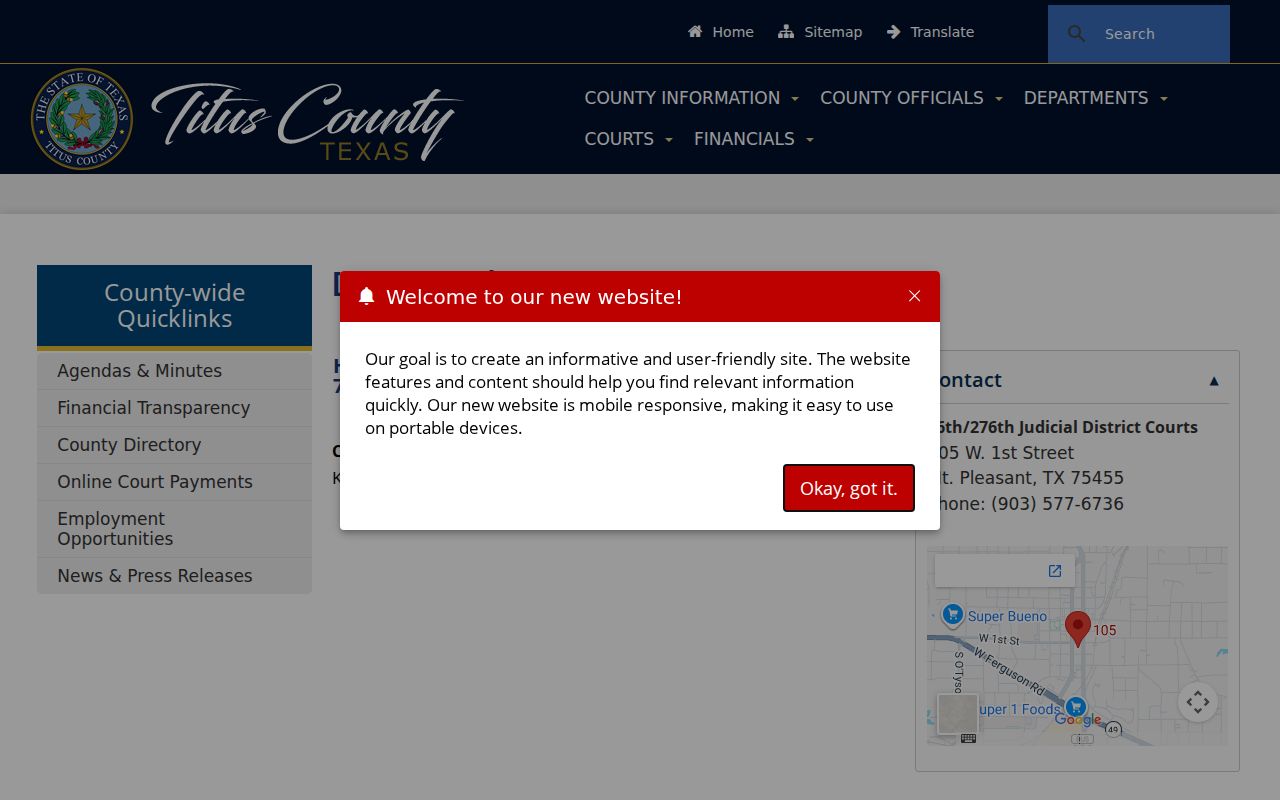
Civil docket settings for Titus County trace back to the two district courts. Those courts share one scheduling contact. County Court and JP matters are different. For those, confirm with the office that actually holds the case. A “docket call” is not the trial. It can be a calendar call for readiness, assignment, or a reset, and a stale date may linger in the register after a later order moves the case. The Titus County court schedule lays out the fuller way to check a setting.
Titus County Civil Filing Traps
Some civil docket terms in Titus County read as final when they are not. “Motion filed” only notes the request arrived, not that the judge ruled. “Citation issued” is not “citation served.” A hearing setting does not prove the hearing ever took place. “Nonsuit,” “dismissal,” and “judgment” each carry their own meaning. So never swap one for the rest.
- Return of service
- The filed report of service or attempted service, separate from issuance.
- Nonsuit
- A party’s procedural step ending some or all claims, subject to the record and rules.
- Dismissal
- A court disposition that may be based on procedure or merits.
- Judgment
- A court ruling that resolves claims or grants relief, sometimes followed by enforcement or appeal.
Scan the docket forward until you reach a signed order or other disposition entry. If an entry's wording leaves you unsure, pull the linked document or ask the Titus County clerk's office for a copy.
Who Can See Civil Dockets
Texas court records start out open to the public, but sensitive material can be sealed or restricted. Texas Rule of Civil Procedure 76a spells out the findings and steps for sealing covered court records. Texas Rule of Judicial Administration 12 controls access to judicial records within its scope. The Texas Public Information Act works alongside neither; it does not replace those court-record procedures. Family, juvenile, adoption, and child-protection files may mask names or documents even when a limited entry or calendar date stays public. Personal identifiers get masked too. A gap tells you nothing about what sits behind it.
Access rule: Ask the clerk for the specific record and desired copy format. If access is denied, request the governing rule, sealing order, or written reason.
Titus County Civil Docket Copies
County Clerk civil coverage runs from 1983 forward. Anything older may take a clerk or archival search. Plain copies from the County Clerk cost $1 per page, and certification adds $5. Mailed requests must include a self-addressed stamped envelope. The office posts no civil-image price, no turnaround promise, and no public terminal that covers everything.
Route your copy request to the right office: the District Clerk for district civil and family cases, the County Clerk for County Court civil records, and the JP clerk for precinct civil matters. Give the cause number, the court, the parties, the document title or entry date, and say whether you need a certified copy. Certification is what counts when the recipient wants an official judgment, not just a portal printout.
No result: Check the other Titus County civil custodian, confirm the cause number format, and ask whether the file is older, restricted, or not integrated online.
Plan a name or number search through the county’s Titus County docket search. The clerk who took the filing remains the source of the original record.