
Titus County Criminal Docket Searches
Check the paperwork first. The citation, notice, bond paper, or prior order names the court you need. Felony files live with the Titus County District Clerk. They are heard in either the 76th or 276th District Court. Class A and B misdemeanors belong to the Titus County Clerk and Constitutional County Court. Class C appeals out of a justice or municipal court go there too. A fine-only case stays with the issuing Justice Court or Mount Pleasant Municipal Court unless appealed. The County Clerk Court Records page leads into Texas Online Records. That system currently opens to account login and registration. It offers no anonymous name or cause-number form. The District Clerk page offers contact and filing resources, but it provides no open felony case lookup.
- Identify the issuing court and offense level from the document in hand.
- Use the County Clerk route for county misdemeanors or the District Clerk for felonies.
- Give the clerk the full cause number, defendant name, and approximate filing date.
- Review each dated entry for charge, setting, plea, order, and disposition.
- Request a plain or certified copy from the custodian when proof is required.
Appeals go elsewhere. Use TAMES and search by appellate number, trial number, style, or county, keeping in mind the system refreshes nightly and never replaces the trial docket itself.
Titus County Criminal Portal Limits
The Titus Texas Online Records portal opens with Email or Username and Password fields. Login, Forgot Password, and Register controls sit alongside them. No criminal-case search fields appear for the public. Do not count on an open defendant-name docket search there. The manifest comes from that portal landing page. It records the access point as it stands.
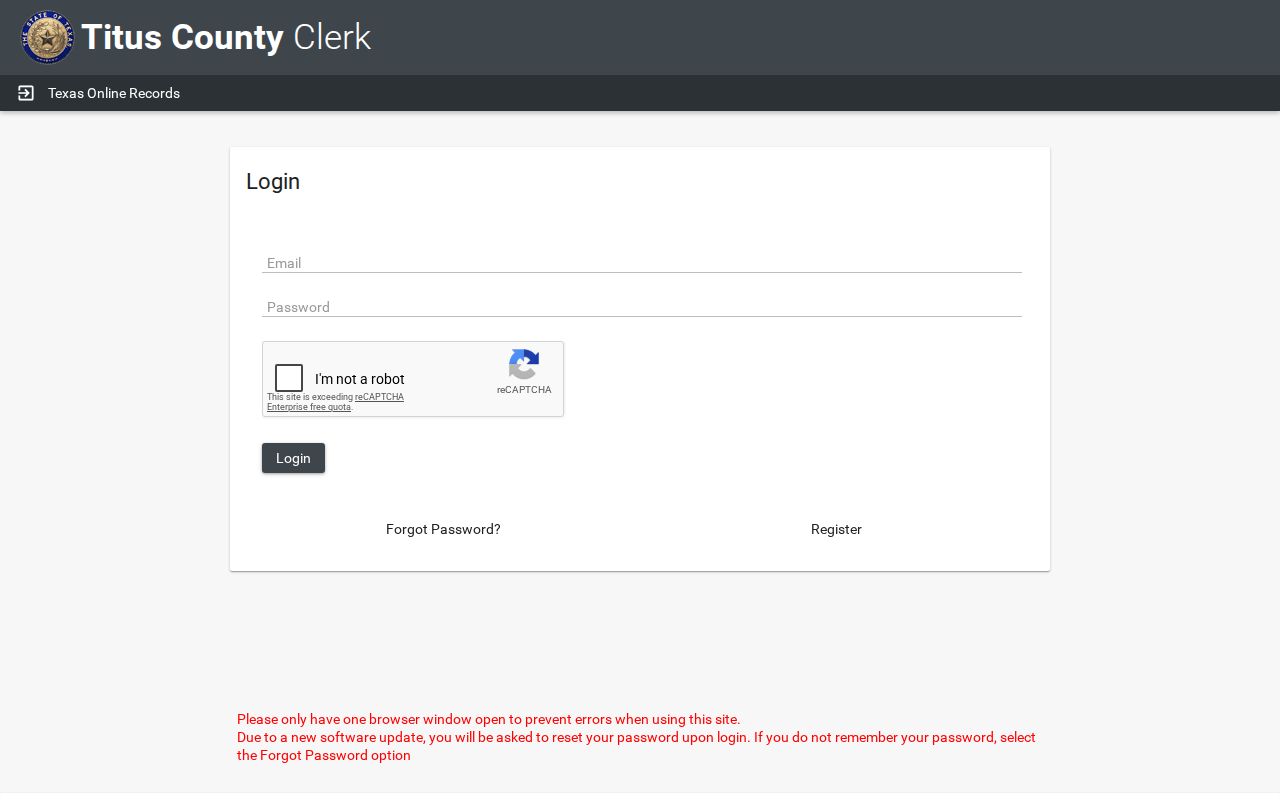
A login screen is only a gateway. It does not prove any given Titus County criminal docket or scanned filing waits behind it. If access stops there, contact the correct clerk instead of guessing at hidden fields.
| Channel | Best use | Limit |
|---|---|---|
| County Clerk and NetData | County misdemeanor and Class C appeal route | Current login gate |
| District Clerk | Felony file and copies | No anonymous field page documented |
| re:SearchTX | Civil and non-criminal material | Not a complete criminal docket |
| JP or city court | Fine-only cases | Contact the issuing court |
Criminal Dockets: What They Show
Think of a Titus County criminal docket as a dated register rather than the full evidence file. Entries may list the court, cause number, style, filing date, charge, attorneys, status, settings, and rulings. These are the field categories a docket uses, not a sample lifted from any private case.
| Cause number | The local identifier. Keep every prefix, year, dash, and digit exactly as issued. |
|---|---|
| Charge block | Offense, count, class, and statute when displayed. |
| Setting | Date, time, courtroom, judge, and hearing stage when available. |
| Event entry | A filed motion, notice, order, plea, reset, or judgment. |
| Disposition | Dismissal, acquittal, conviction, deferred result, or sentence. |
| Appeal marker | Notice, record preparation, transfer, or related appellate cause. |
Read the labels with care. "Filed" means the clerk accepted a document, not that the judge granted it. A listed hearing date proves nothing either, so look for a later order, minutes, judgment, or disposition before drawing conclusions.
Titus County Criminal Costs Explained
Money entries sit beside the procedural record, but they describe different things. A bond sets the conditions of release. A forfeiture is a later event tied to that bond. Court costs, fines, restitution, time-payment charges, and balances can fill a financial block, yet none of them alone states the full sentence or proves the current amount due.
- Bond
- Security or conditions tied to release while the case is pending.
- Forfeiture
- A separate event that may follow a failure to meet bond terms.
- Disposition
- The recorded outcome, such as dismissal, acquittal, conviction, or deferred adjudication.
- Sentence
- The punishment or conditions imposed after a qualifying disposition.
The County Clerk publishes examples of misdemeanor costs. Schedules can change, though, and case-specific additions may apply. Confirm the balance with the court, because a payment screen is not a certified criminal register.
Criminal Case Stages on the Docket
A district felony docket often opens with a complaint or indictment. Appearance and arraignment entries follow. Pretrial events can include discovery notices, subpoenas, motions, waivers, and signed orders, and settings may be added, passed, or reset along the way. A plea hearing or trial then leads toward judgment, disposition, and sentencing. County misdemeanor files follow a similar path, though the charging instrument and fields may differ.
Docket flow: Charge Filed › Arraignment › Pretrial › Plea or Trial › Disposition › Sentencing
Judge a case by its sequence, not one line. A not-guilty plea is a procedural position, not a final result, and a motion entry is not a ruling. "Reset," "passed," or "off docket" does not mean dismissal unless a later order or disposition says so.
Titus County Criminal Setting Checks
When the portal demands a login or the online record seems stale, call instead of guessing. The court coordinator handles settings for the district courts. You can reach that office through the county's district judges page, which lists the shared coordinator line at (903) 577-6736. When you call, ask for the court, the date, the time, the courtroom, the setting type, and whether the case was reset. The clerk keeps the case file itself. The coordinator is the one who tracks current district settings on the criminal docket.
One more access point exists on the vendor side. The NetData Titus source offers a local gateway for records plus a link for paying traffic tickets.

That gateway does not turn a traffic payment route into a felony search. Follow the court named on the notice and call that office when a setting is urgent.
Setting check: Keep the cause number ready and confirm a near-term date directly. An old entry can remain visible after a later reset.
Titus County Criminal Docket Courts
More than one office keeps a Titus County criminal docket. The split turns on offense level and where the case began. A felony request sent to the County Clerk, or a JP citation request sent to the District Clerk, only delays the search.
| Case class | Court | Custodian |
|---|---|---|
| Felony | 76th or 276th District Court | District Clerk |
| Class A or B misdemeanor | Constitutional County Court | County Clerk |
| Fine-only or traffic | Justice Court | Precinct clerk |
| City ordinance or Class C | Mount Pleasant Municipal Court | Municipal clerk |
| Appeal | Sixth Court of Appeals | Appellate clerk |
A Class C appeal can later show up in the County Clerk's misdemeanor scope while the original citation stays tied to the lower court. Track the full path by searching both court records.
Titus County Docket Verification
The County Clerk calls its online database real-time, "as is," and not for official use. A portal printout can locate a record, but it is no substitute for a certified docket or judgment. The official Court Records notice supplies that warning.
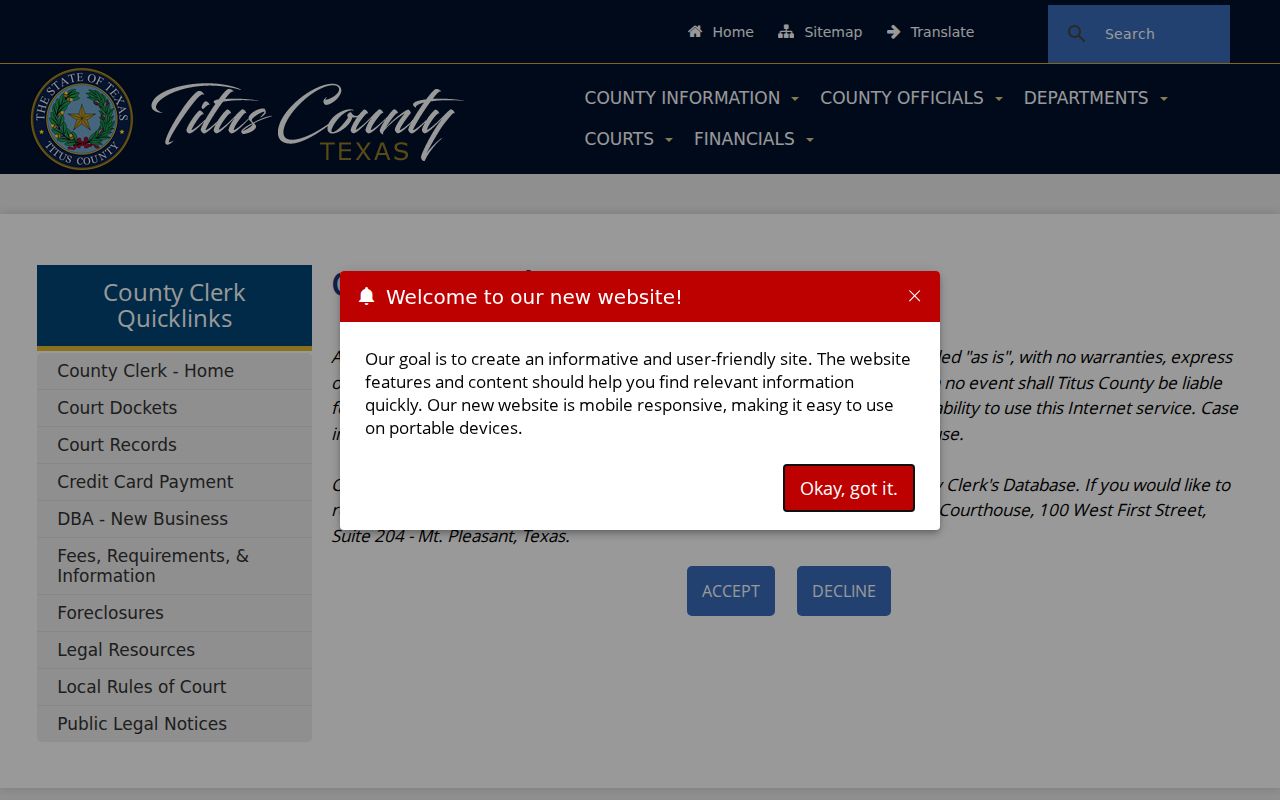
A quick check with the clerk settles any doubt about a Titus County criminal docket. Plain copies from the County Clerk run $1 per page. Certification adds $5. When you use the misdemeanor form, list the cause number and the document you want. Choose whether to pay for certification. Give your own details, and include a self-addressed stamped envelope if you want the copies by mail.
Access Rules for Criminal Dockets
Plenty of adult criminal entries are open in Titus County, but access has limits. Texas Rule of Judicial Administration 12 governs judicial records. Court files do not flow through the Texas Public Information Act the way executive records do, because Government Code section 552.0035 leaves judiciary information to court rules or other law.
Juvenile files raise another barrier. They can be confidential under Texas Family Code chapter 58, and sealed, expunged, or nondisclosed matters may not appear at all or may be restricted. A docket search that comes up empty is not proof the case never existed. The miss could simply mean you asked the wrong clerk, hit old coverage, faced a login gate, or used a different number format.
Access rule: Do not bypass a restriction. Request the specific judicial record and ask for the governing rule or order if access is denied.
Titus County Criminal Docket Copies
For felony copies, go to the District Clerk. Misdemeanors handled in County Court, along with Class C appeals, belong to the County Clerk. Lower-court files sit with the JP precinct or the Mount Pleasant Municipal Court. A case may have moved up to the Sixth Court of Appeals. If so, pull both cause numbers, since each court keeps its own register.
A written request works best. It should name the court, the cause number, the defendant, the document or entry date, and the type of copy you want. Mail the County Clerk a self-addressed stamped envelope with your request. The clerk makes no official turnaround promise, so ask about timing before you drive over. For a wider view of Titus County court records, the Titus County docket search page explains the routing. It shows how to run a search by name or case number.